
Get Your Christmas Shopping Done With The Co-op and Girls Can Tell!
Now is the time to become a member! Join using our online form or come out and join in-person at Girls Can Tell on Thursday, December 13th.
If you are already a member, stop by and say hello on December 13th - and bring any of your friends who might be interested in joining!
Top 5 Reasons to Attend Co-op Brew Day (space is limited!)
As we told you earlier, the South Philly Food Co-op is holding a great event—Co-op Brew Day!— from noon till 5 p.m. on Dec. 1 for anyone interested in homebrewing (or simply interested in beer): Award-winning homebrewers Andy and Sean Arsenault will lead a workshop in which they demonstrate how to brew a Sugarplum Porter, the perfect beer to kick of your holiday season.
Since the event is almost at capacity (seriously, if you're on the fence, don't sleep on this), we asked Andy Arsenault, a brewer at Downingtown's Victory (and, what do you know, a Co-op member, too) to fashion his Top 5 reasons to sign up for this great event where you'll learn about making great beer, support The Co-op, and, of course, learn about the benefits of membership.
Take it away, Andy:
- There will be free beer.
- There will be homemade doughnuts.
- There will be homemade sugar plums.
- You'll get to meet Minnie, our sassy 95-year-old neighbor. She usually helps out with the brewing.
- You'll get to learn about the SOUTH PHILLY FOOD CO-OP!!!
How's that?!
Sounds great to us. Hope to see you there!
The event will take place at the Arsenaluts’ home at 732 Clymer St. Tickets are just $15 for members, $20 for non-members, and can be purchased at Eventbrite.
And remember: Becoming a member is easy. Why not join right now and attend at the member rate?
Make the Co-op Happen! Upcoming Volunteer Opportunities
VOLUNTEER OPPORTUNITIES
ONGOING VOLUNTEER OPPORTUNITIES
Looking to get know your Co-op community and South Philly better? Why not jump in and help on some the projects below? If you want to make some new friends, meet future pet sitters, or find that neighbor who will help you fix a broken water heater on a Sunday morning, working with our committees is a great way to build these connections. While experience is great, it's not needed - we love volunteers with enthusiasm and a desire to learn new skills. Help us find more members Eager to see us reach our next membership goal and move on to opening the Co-op? Consider joining the Membership Committee. This winter we are focusing on developing materials and events to assist our current members in recruiting their friends and neighbors. If you are Interested in helping us tap into our current member networks or if you want to bring your own ideas for recruiting new members, please email [email protected] to get information about our meetings. Help with social media and blog posting We are looking for someone to help operate a Facebook/Twitter feed and help out with posting things (you don't necessarily have to write them!) to a wordpress blog. Help us keep track of potential funders We're looking for El Jefe de Dinero! We need a volunteer to work alongside the Operations committee to maintain our list of potential grantors and financing agents. We’ve brainstormed a lot of potential sources of money and need an organized person to help keep us all in check. This will include researching potential lenders and other sources of funding that we identify together, maintaining the list of prospects and action items, and cracking the whip on the Operations committee. If you’re an organized person who's interested in project management, helping from home, strategic planning, development or fundraising, and willing to make some preliminary contact with nice people who like to give out money, then your Co-op needs you! This will take up approximately 4-5 hours of time per month. Help members get more discounts at local businesses We are looking for 1-2 outgoing folks who are able to follow-up with targeted business for our Shop South Philly program. You will help in securing discounts for our members at these local businesses. Volunteers can work independently on their own time for a few hours each month. Help find event sponsors Have a background or interest in sales or fundraising? You are the perfect volunteer to work on securing sponsors for all our Programs and Events. You'll work with the committee as they identify businesses who could help offset costs for our events. We're searching for 2-4 volunteers who have a few hours each month to commit to letter writing and follow-up phone calls. You can work on your own time and attend the occasional (very fun) Programs and Events meeting. Like running? The Programs and Events committee is considering organizing a South Philly 5K run this spring. We need 2-5 people who will research logistics, sponsorships, and marketing to determine if we want to present this event. If you like organizing, research, or running, this is the volunteer opportunity for you! Volunteering is a great way to help the Co-op advance its main goal of the moment: getting to 400 members! If you are currently a member-owner, volunteering at any of these events will count toward your household’s annual 8 hour volunteer commitment. For those who haven’t become members yet but are interested in volunteering, your hours are being tracked and will be applied to your account when you join. Email [email protected] if you can help out with any of these events or activities. Need more info? Email [email protected].Sarah's Garden: November
Learn to Home Brew! Sugarplum Porter Workshop with Award-winning Home Brewers Sean and Andy Arsenault
Have you been meaning to get into brewing your own beer but haven't known where to start? Do you brew your own beer and want to mingle with other home brewers? Are you just really into beer and sort of want to know how it's made but really just want to drink some really interesting beer?
No matter what your motivation, we've got an event guaranteed to, ahem, generate some buzz. Support the South Philly Food Co-op and sample some heady homebrews at Co-op Brew Day: Home Brewing Workshop with the Brothers Arsenault.
On Sat., Dec. 1, from noon till 5 p.m., Sean and Andy Arsenault, winners of Home Sweet Homebrew's Extreme Home Brew Challenge, will lead a workshop in which they demonstrate how to brew a Sugarplum Porter, just the beer to kick of your holiday season.
But who are these brothers Arsenault? Andy is a brewer at Downingtown's Victory and a longtime volunteer on the Co-op's Programs and Events committee. Sean is the quintessential beer adventurer, having traveled near and far to sample the world's rich, barley-laden bounty.
As no home brew demonstration would be complete without a little liquid refreshment to wash all that learning down, Sean and Andy will be providing to attendees samples of their previous concoctions. They also encourage fellow home brewers to bring a growler or a sixpack of their own handwork for sharing and feedback.
The event will take place at the brothers' home at 732 Clymer St. Tickets are just $15 for members, $20 for non-members, and can be purchased at Eventbrite.
And remember: Becoming a member is easy. Why not join right now?
Join us for pizza and a movie this Wednesday 11/14 at Nomad Pizza
Potato Cauliflower Soup

I've been traveling for work, and staring at hotel carpeting. I don't do a ton of traveling but this past month or so has been exhausting. I spent more time elsewhere than I did here. So I've seen an array of conference center rugs*, but I haven't seen my kitchen.
Which means I haven't been cooking, because you know, I've been elsewhere, and that I came home and had no idea what was in the fridge or freezer. So I had to do a serious overhaul/cleanout/accounting for what's what like I did a while back.
The magical part of doing that was finding soup in my freezer. Chicken soup and butternut squash soup and potato cauliflower soup. Finding soup in the freezer isn't like finding frozen tofu or leftover pasta sauce. With soup, you're already there. It's dinner.
Before I left, I had made up a lot of potato cauliflower soup. I don't find a lot of use for potatoes, and potato soup has a guilt-laden heaviness to it that stems from the clear association between potatoes and saddlebags--an association often forgiven in the face of french fries.

Still, somehow soup sounds like I'm pretending. "Oh, it's healthy, it's soup." "No, it's potatoes." But when I found myself with these potatoes, I also found myself with a head of cauliflower. And if there's one thing cauliflower does well**, it's pretending to be a potato.

I started with five medium-smallish potatoes, but use what you have. This is so flexible, just adjust your liquid and your spices to accomodate what you have on hand. My potatoes are whatever thin-skinned varieties are grown locally. You could peel them in advance, but I just took the skins off by hand after they had boiled. This requires either patience or asbestos-fingers like I have. I can touch hot things and get away with it.
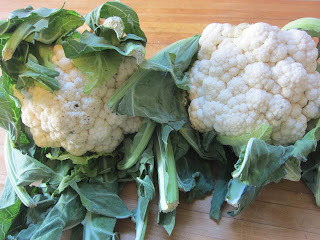
I also had two medium-ish heads of cauliflower, so this is as much cauliflower as potato. I set my quartered potatoes in a pot of water to soften (imagine you're making mashed potatoes) and laid out my cauliflower florets with some garlic (4 cloves) and onion (half a medium white one) on a baking sheet.

I hit the veggies with a spritz of olive oil and a dash of salt and pepper, and set them in a 400 degree oven to soften for 30 minutes.


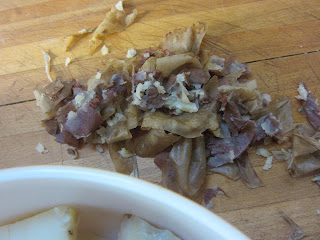
Once my potatoes were fork-tender (25 minutes?) I took them out and peeled them by hand.

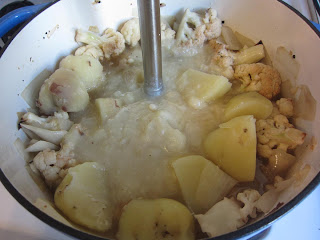
Taters, cauliflower, onions and garlic all went into a pot with enough vegetable stock to just about cover them, and simmered for just a couple of minutes - you want your cauliflower to be tender enough to blend.

I used my emulsion blender (but you can use a standard blender, carefully) to blend it until it was soup, adding more stock as needed. I got up to three cups of stock, but this is going to vary based on what you start with and the texture you're after.
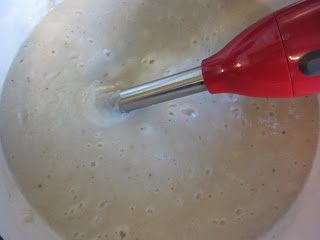
Season to taste. I added more salt and pepper at this point. And then it's all about customization. Right now, I have a lovely vegan soup.

Add chives if you have them, or scallions.
If you're doing dairy, add some shredded cheddar.

And/or maybe some sour cream.

Or go all out and add some bacon. Either way, it's rich and creamy and satisfying.

This recipe is cross-posted at Saturday’s Mouse, where I’m working on making food out of food.
*See this post on SaturdaysMouse.com for full analysis of conference center carpets.
**Cauliflower does plenty of things well.
Potato Cauliflower Soup
The rich goodness of potato soup with fewer calories and some extra vitamins. Ignore all of that and it's still warm and creamy and comforting.
Ingredients
- 3 cups potatoes, quartered
- 3 cups cauliflower, in florets
- 3 cups vegetable stock (unsalted)
- 1 tablespoon oil (something mild)
- 1/2 medium onion
- 3 cloves garlic
- 1 tablespoon (or less, to taste) salt
- 1/2 tablespoon (to taste) black pepper
Instructions
Boil potatoes (peel first if that's easier for you) until fork tender.Roast cauliflower, onion and garlic for half an hour or so at 400 until tender, with some oil and salt and pepper. Add potatoes, cauliflower, onion and garlic to a large pot and add vegetable stock until just about covered. Simmer until soft enough to blend. Blend. Add stock as needed. Season to taste and serve. OPTIONAL: Top with chives or scallions, cheese, sour cream or bacon.
Details
Prep time: 5 mins Cook time: 40 mins Total time: 45 mins Yield: 8-10 servings
Timeline for opening now available!
Sarah's Garden: Two Years and No Eggplant
eggplant flower
Just a short post to point out that it's been two years that I've planted eggplants from seed and two years with no eggplants to eat. Both years I've gotten flowers and that's all. I'm going to try starting them earlier next year since that's all I can think to do. Any suggestions, fellow eggplant lovers?
Today's the Day! Join us for the Fall General Membership Meeting
Visit NBCNews.com for breaking news, world news, and news about the economy