
Philly's Home Grown Institute Holding Spring Conference 3/24 and 3/25
This is to let folks in the greater Philadelphia area know that a new non-profit, the Home Grown Institute, is organizing a 2-day "Springing Good Intentions Into Action" conference to be held at Springside Chestnut Hill Academy (500 W Willow Grove Ave, Phila 19118) on March 24-25.
The Saturday evening dinner program will feature information about the Mid-Atlantic Food Co-op Alliance and all the start-up efforts in the area followed by a presentation by Creekside Co-op in Elkins Park, which had its ground breaking on February 2.
Below is a description of the conference.
50+ Hands-on Home-Scaled Sustainable Skills Workshops including:
Share
- edible gardens,
- community and school gardens
- seed-saving, soil enrichment, 4-season harvest
- bees, chickens, worms (oh my!) and aquaponics
- food preservation, fermentation, mycology
- repurposing, upcycling, natural building
10 Reasons Co-ops Rock from Co-opoly
I've had this sitting in my email inbox for just over a month and finally am getting around to sharing it. Co-op Board President Alison Fritz (full disclosure: my beloved wife) emailed it with the suggestion that each of these points would be great for talking about the Co-op and co-ops in general with people that we're trying to recruit as new members. So for all of our current members out there who are trying every day to get the Co-op to our first goal of 250 Founding Members (this link takes you to our new, easy-to-use online member-owner application!), feel free to commit these to memory as great little talking points for why a cooperative would be such a good thing to have in our neighborhood. In the near future we're hoping to compile a similar list that is more specific to the South Philly Food Co-op itself. (I don't want to promise that it will be a top 10 list, mostly because I don't want to limit us to just 10!)
And please consider jumping over to Co-opoly's site and pick up one of these really cool Top 10 Reasons Co-ops Rock posters for yourself for just a $5 suggested price. It'll make me feel less bad for reprinting them in their entirety below. But you really should see them on the poster... very cool looking.
So here they are.
Share
- Cooperatives are democratic businesses and organizations, equally owned and controlled by a group of people. There are worker co-ops, consumer co-ops, producer co-ops, financial co-ops, housing co-ops, and more. In a cooperative, one member has one vote.
- Because cooperatives are democratically owned by community members, co-ops keep money (and jobs) in their communities.
- Cooperatives aren’t a far off theory. Cooperatives offer achievable and practical solutions to many economic, environmental, and social problems that can be implemented right now.
- Co-ops aren’t charity; they’re empowering means for self-help and solidarity.
- Members of cooperatives equally share the burden in hard times and equally share the benefits in good times.
- Cooperatives are more resilient in economic downturns and in impoverished communities. When other businesses may shut down or lay off workers, co-op members pull together to work out solutions.
- Cooperatives are an international movement. There are thousands upon thousands of cooperatives around the world that are making major differences locally and globally.
- Cooperatives strive to make people’s lives, communities, and economies more just, equitable, and democratic.
- There’s no one right way to do a co-op. They can be flexible to fit different community and individual needs. There are big co-ops with thousands of members, and there are small co-ops with 3 members.
- Cooperatives are viable and just alternatives for meeting our economic and social needs in contrast to corporations that exploit people and the planet.
Sarah's Garden: Seeds! Seeds! Seeds!
This weekend is seed planting time! Here's what I'm going to start with:
[caption id="" align="alignnone" width="375" caption="clockwise from top left: Copia, Rutgers, Dr. Walter and Jersey Giant"]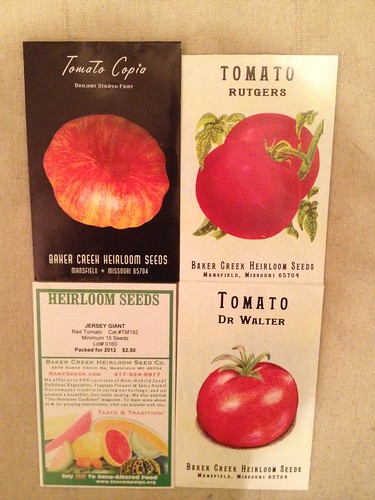 [/caption]
First off: tomatoes! I'm branching out a little this year and trying some different varieties. My beefsteaks last year were very tasty but I definitely think they needed more space. So these are all slightly smaller since I read quite a few things saying that smaller tomatoes need less growing space. I never seem to eat cherry or grape tomatoes so we'll see how these work. The Copia is orangey with stripes and the rest are red; I tried to pick ones from New Jersey or around this area because I figure if this is the climate they're used to then maybe they'll grow better? Not that my tomatoes last year had any trouble growing...
[caption id="" align="alignnone" width="500" caption="peppers and eggplants"]
[/caption]
First off: tomatoes! I'm branching out a little this year and trying some different varieties. My beefsteaks last year were very tasty but I definitely think they needed more space. So these are all slightly smaller since I read quite a few things saying that smaller tomatoes need less growing space. I never seem to eat cherry or grape tomatoes so we'll see how these work. The Copia is orangey with stripes and the rest are red; I tried to pick ones from New Jersey or around this area because I figure if this is the climate they're used to then maybe they'll grow better? Not that my tomatoes last year had any trouble growing...
[caption id="" align="alignnone" width="500" caption="peppers and eggplants"]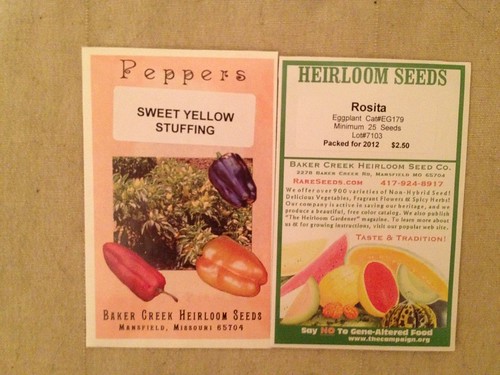 [/caption]
Some other nightshades: sweet yellow peppers and eggplant. I don't actually like peppers but apparently they grow very well with tomatoes and I'm curious to see how they do. And the eggplant, well, I didn't get even one eggplant from my Black Beauty eggplants last year so I decided to switch it up and try a different variety. I'm not ready to give up on eggplant yet!
[caption id="" align="alignnone" width="500" caption="thyme, basil"]
[/caption]
Some other nightshades: sweet yellow peppers and eggplant. I don't actually like peppers but apparently they grow very well with tomatoes and I'm curious to see how they do. And the eggplant, well, I didn't get even one eggplant from my Black Beauty eggplants last year so I decided to switch it up and try a different variety. I'm not ready to give up on eggplant yet!
[caption id="" align="alignnone" width="500" caption="thyme, basil"]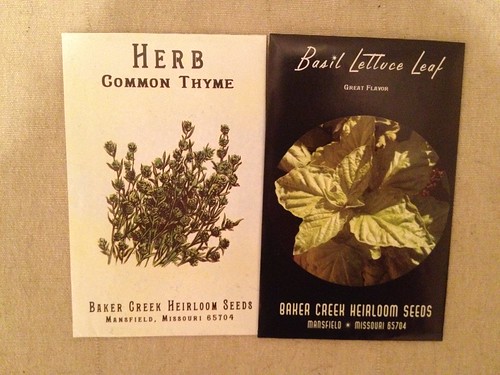 [/caption]
My two favorite herbs are thyme and basil and I already have mint and rosemary outside so together these make a pretty good herb garden. I've never grown thyme before and it might be a little silly to grow from seed but I'm giving it a try. And the basil is actually the same variety I grew last year. It was so easy and I liked the taste of it so much that I'm growing it again! I'm looking forward to more pesto so I can make my favorite sandwich in the world: tomato, mozzarella and pesto.
[caption id="" align="alignnone" width="500" caption="arugula, spinach and lettuce"]
[/caption]
My two favorite herbs are thyme and basil and I already have mint and rosemary outside so together these make a pretty good herb garden. I've never grown thyme before and it might be a little silly to grow from seed but I'm giving it a try. And the basil is actually the same variety I grew last year. It was so easy and I liked the taste of it so much that I'm growing it again! I'm looking forward to more pesto so I can make my favorite sandwich in the world: tomato, mozzarella and pesto.
[caption id="" align="alignnone" width="500" caption="arugula, spinach and lettuce"]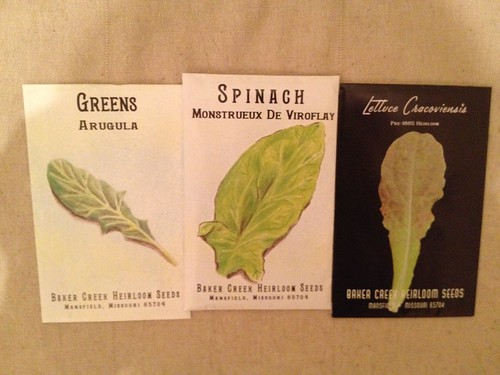 [/caption]
And greens! It's not really the right time to plant these - they don't like really hot weather so they do best in spring and fall - but they all grow fairly quickly (about a month and half or two months to harvest.) And the thing with these greens is that it never hurts to pick them early to eat because baby spinach and baby arugula and baby lettuce are not only more adorable but often tastier. These three are all from last year and I don't think that should be a problem but who knows. Clearly if my seeds don't sprout I will blame it on that fact.
And that's enough to start! I doubt I'll have much to show for a few weeks but we will see. I remember being quite surprised at how quickly my seedlings appeared last year.
[/caption]
And greens! It's not really the right time to plant these - they don't like really hot weather so they do best in spring and fall - but they all grow fairly quickly (about a month and half or two months to harvest.) And the thing with these greens is that it never hurts to pick them early to eat because baby spinach and baby arugula and baby lettuce are not only more adorable but often tastier. These three are all from last year and I don't think that should be a problem but who knows. Clearly if my seeds don't sprout I will blame it on that fact.
And that's enough to start! I doubt I'll have much to show for a few weeks but we will see. I remember being quite surprised at how quickly my seedlings appeared last year.
Share
[/caption]
First off: tomatoes! I'm branching out a little this year and trying some different varieties. My beefsteaks last year were very tasty but I definitely think they needed more space. So these are all slightly smaller since I read quite a few things saying that smaller tomatoes need less growing space. I never seem to eat cherry or grape tomatoes so we'll see how these work. The Copia is orangey with stripes and the rest are red; I tried to pick ones from New Jersey or around this area because I figure if this is the climate they're used to then maybe they'll grow better? Not that my tomatoes last year had any trouble growing...
[caption id="" align="alignnone" width="500" caption="peppers and eggplants"][/caption]
Some other nightshades: sweet yellow peppers and eggplant. I don't actually like peppers but apparently they grow very well with tomatoes and I'm curious to see how they do. And the eggplant, well, I didn't get even one eggplant from my Black Beauty eggplants last year so I decided to switch it up and try a different variety. I'm not ready to give up on eggplant yet!
[caption id="" align="alignnone" width="500" caption="thyme, basil"][/caption]
My two favorite herbs are thyme and basil and I already have mint and rosemary outside so together these make a pretty good herb garden. I've never grown thyme before and it might be a little silly to grow from seed but I'm giving it a try. And the basil is actually the same variety I grew last year. It was so easy and I liked the taste of it so much that I'm growing it again! I'm looking forward to more pesto so I can make my favorite sandwich in the world: tomato, mozzarella and pesto.
[caption id="" align="alignnone" width="500" caption="arugula, spinach and lettuce"][/caption]
And greens! It's not really the right time to plant these - they don't like really hot weather so they do best in spring and fall - but they all grow fairly quickly (about a month and half or two months to harvest.) And the thing with these greens is that it never hurts to pick them early to eat because baby spinach and baby arugula and baby lettuce are not only more adorable but often tastier. These three are all from last year and I don't think that should be a problem but who knows. Clearly if my seeds don't sprout I will blame it on that fact.
And that's enough to start! I doubt I'll have much to show for a few weeks but we will see. I remember being quite surprised at how quickly my seedlings appeared last year.
The Co-op and local job creation (and retention!)
I'm not going to go out on a limb and say that just because you join the Co-op means that we'll bring thousands of new, well-paying jobs to South Philadelphia. But it is worth noting that the Co-op would be a piece of an overall food system puzzle in which the owners of the enterprise (you) place a value on supporting the other pieces of that puzzle, which themselves create and sustain good jobs all over the region.
I bring this up because of a recent Treehugger piece which made the point about the job creation power of small, family farms. In fact, the numbers on the return on investment on many different programs that support these kinds of farms are staggering. A program meant to help tobacco farmers transition to sustainable farming of more diversified agriculture "awarded $3.6 million in three years to 367 farmers, created 4,100 new jobs, and had an economic impact of more than $733 million."
As for the Co-op, it's important to remember that while large retailers have their ups and downs (and the downs are mostly suffered by the people at the bottom of their organizational charts), a Co-op can be a more resilient business model because the member-owners come together in times of trouble to see the Co-op through until the economy picks up again. And now, while we're just starting to come out of some pretty big economic trouble, wouldn't it be good to be prepared for the next downturn?
(Join the Co-op today... we've made it easy with our new online form.)
Share
Sarah's Garden: Happy March!
Back when I was growing up in cold, cold New England, March didn't mean much more than snow or possibly slush, if we were lucky and it warmed up to above freezing. The old saying that March comes in like a lion and goes out like a lamb never made any sense to me: it came in and out like a lion in my experience, and the first month that you could just about guarantee that there'd be no snow was May (I'm only slightly joking.) But here! In the glorious and warm Mid-Atlantic, March is a wonderful month. Here, March means that spring is coming. You can feel the sun getting stronger and once in a while you can even smell spring, as long as you are outside the 1/2 mile Pat's and Geno's cheesesteak smell radius.
I kid, Philadelphia. But it's true that March is a wonderful month, if only for the fact the the few months after it (April, May, June) are some of the nicest temperature-wise. The other day I went out into the garden, dormant except for that crazy ivy, to get some containers and figure out where things should go. And lo! (Sorry.) There was something still growing:
[caption id="" align="alignnone" width="375" caption="swisssssss chard"] [/caption]
Chard! I didn't take any of my failed chard or kale out last fall since I was hoping that some of it might come back in the spring. Well, it sort of did. This little guy is very small, but he's growing. I picked one of the leaves to try and I can tell you that it was crunchy and tasted...fresh...but that's about all I can say since I had just finished eating a Cadbury Creme Egg about a second before I put the leaf into my mouth. Oops!
[caption id="" align="alignnone" width="375" caption="pretty"]
[/caption]
Chard! I didn't take any of my failed chard or kale out last fall since I was hoping that some of it might come back in the spring. Well, it sort of did. This little guy is very small, but he's growing. I picked one of the leaves to try and I can tell you that it was crunchy and tasted...fresh...but that's about all I can say since I had just finished eating a Cadbury Creme Egg about a second before I put the leaf into my mouth. Oops!
[caption id="" align="alignnone" width="375" caption="pretty"] [/caption]
Unfortunately, that's really the only one that made it. You see, I planted the chard and kale seeds in a self-watering planter. Good idea, right? We've already covered that I'm bad at watering. The self-watering planter came with a plastic cover and one day I got all cocky and decided that I didn't need that ugly plastic cover. Ha! Unfortunately, I think I really did need that ugly plastic cover because after I took it off the soil was always really wet. And something appears to be eating the kale?
[caption id="" align="alignnone" width="500" caption="sad"]
[/caption]
Unfortunately, that's really the only one that made it. You see, I planted the chard and kale seeds in a self-watering planter. Good idea, right? We've already covered that I'm bad at watering. The self-watering planter came with a plastic cover and one day I got all cocky and decided that I didn't need that ugly plastic cover. Ha! Unfortunately, I think I really did need that ugly plastic cover because after I took it off the soil was always really wet. And something appears to be eating the kale?
[caption id="" align="alignnone" width="500" caption="sad"]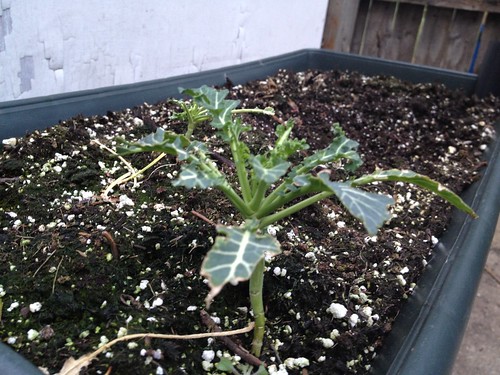 [/caption]
Oh well. I'll continue to tend to my one little chard.
Soon it will be time to plant seeds! More on that next week. For now, here are some little snowdrops brightening my walk to work in the morning:
[caption id="" align="alignnone" width="500" caption="lovelies"]
[/caption]
Oh well. I'll continue to tend to my one little chard.
Soon it will be time to plant seeds! More on that next week. For now, here are some little snowdrops brightening my walk to work in the morning:
[caption id="" align="alignnone" width="500" caption="lovelies"] [/caption]
Share
[/caption]
Chard! I didn't take any of my failed chard or kale out last fall since I was hoping that some of it might come back in the spring. Well, it sort of did. This little guy is very small, but he's growing. I picked one of the leaves to try and I can tell you that it was crunchy and tasted...fresh...but that's about all I can say since I had just finished eating a Cadbury Creme Egg about a second before I put the leaf into my mouth. Oops!
[caption id="" align="alignnone" width="375" caption="pretty"][/caption]
Unfortunately, that's really the only one that made it. You see, I planted the chard and kale seeds in a self-watering planter. Good idea, right? We've already covered that I'm bad at watering. The self-watering planter came with a plastic cover and one day I got all cocky and decided that I didn't need that ugly plastic cover. Ha! Unfortunately, I think I really did need that ugly plastic cover because after I took it off the soil was always really wet. And something appears to be eating the kale?
[caption id="" align="alignnone" width="500" caption="sad"][/caption]
Oh well. I'll continue to tend to my one little chard.
Soon it will be time to plant seeds! More on that next week. For now, here are some little snowdrops brightening my walk to work in the morning:
[caption id="" align="alignnone" width="500" caption="lovelies"][/caption]
Notice of Election for Board of Directors - March 15th Deadline
It's almost been a year since our Inaugural Board Elections and there are 5 Board positions to be filled for 2 year terms. If you are interested in leading the South Philly Food Co-op and working on behalf of the member-owners by making the best decisions for them, please submit an application. As a Board Director, you must have time, willingness to prepare for meetings, be attentive to group process, have the willingness to learn, and be willing to assume responsibility for group decisions.
*Please note that a candidate for the Board of Directors must be a member-owner of the Co-op in good standing and must have attended one General Membership Meeting and one Committee Meeting. Click here to review our bylaws.
If you are interested in running for one of the 5 positions, please submit a nomination form with 18 member-owner signatures and your response to the following questions:
1. Why is the South Philly Food Co-op important to you?
2. What has been your involvement with the Co-op to date?
3. How will your experience, skills, or unique perspectives strengthen the Co-op Board?
We will be holding a Nomination Night to help you get signatures (more details to follow). Elections will be held at the General Membership Meeting in May (date TBD). Click here to download the form and to read the specific instructions.
Submit the application form with signatures by March 15, 2012 to Matt Egger [email protected]
- South Philly Food Co-op Election Committee
Share
Parsnip Fritters with Indian Spices
 The parsnip is underrated. I don't give it much attention, and then we're in mid-winter and I'm tired of squash and there's not a lot else going on, and then, there it is, the parsnip. It's a stand-in for potatoes. It's perfect roasted. It's fragrant and slightly peppery but still mild and almost creamy.
I really wanted to make parsnip pakoras. That was the plan. I had these parsnips, and I just thought they wanted to be fried up with some coriander and chili powder and cumin and all.
I thought I had it all together. I didn't have chickpea flour, which really is key, but I had chickpeas, and that was a start. I got my mini-chopper out and loaded it with dry chickpeas. And it laughed at me. And coughed a bit.
The parsnip is underrated. I don't give it much attention, and then we're in mid-winter and I'm tired of squash and there's not a lot else going on, and then, there it is, the parsnip. It's a stand-in for potatoes. It's perfect roasted. It's fragrant and slightly peppery but still mild and almost creamy.
I really wanted to make parsnip pakoras. That was the plan. I had these parsnips, and I just thought they wanted to be fried up with some coriander and chili powder and cumin and all.
I thought I had it all together. I didn't have chickpea flour, which really is key, but I had chickpeas, and that was a start. I got my mini-chopper out and loaded it with dry chickpeas. And it laughed at me. And coughed a bit.
 Plan b. Ok, not pakoras, per se, but fritters. Like a zucchini fritter but with winter veg. And I could still bust out the coriander. This is very similar to the Indian Spiced Vegetable Fritters over on Smitten Kitchen. It's not quite a pakora, but it's delightful next to your curry dish.
I started with two huge parsnips and a tiny one. I gave them a serious scrubbing with a green kitchen scrubber (one that I use only for veg) and passed them to my husband to grate.
Plan b. Ok, not pakoras, per se, but fritters. Like a zucchini fritter but with winter veg. And I could still bust out the coriander. This is very similar to the Indian Spiced Vegetable Fritters over on Smitten Kitchen. It's not quite a pakora, but it's delightful next to your curry dish.
I started with two huge parsnips and a tiny one. I gave them a serious scrubbing with a green kitchen scrubber (one that I use only for veg) and passed them to my husband to grate.
 We didn't end up using all three, but about two cups of grated parsnip.
 And carrots, because they're plentiful right now.
 We cut these into matchsticks for some variation in texture. We also minced a serrano chile and sliced up a small red onion.
 And then the batter. So, yes, if these were real pakoras, they'd be battered in a blend of chickpea flour and rice flour with water and spices, but without chickpea flour on hand I followed the path of the zucchini fritter and broke out the eggs.
 And reminded myself that just because an egg looks different, that doesn't mean it's creepy. I whisked up the eggs in a big bowl.


 Then the veg got heaped on.
 And then I dove in with my hands and mixed it all together. From this point on, I was worthless and sticky, but I had a kitchen partner. If you're going it alone, I'd recommend a spoon.
 We coated the bottom of a skillet with oil (use safflower, vegetable, something without much flavor that can handle high heat), and brought that up to frying temperature (where a bead of water pops when it hits).
Then with my incredibly sticky hand, I grabbed bundles of the mixture and dropped them in. About a third of a cup to a half cup at a time.
We coated the bottom of a skillet with oil (use safflower, vegetable, something without much flavor that can handle high heat), and brought that up to frying temperature (where a bead of water pops when it hits).
Then with my incredibly sticky hand, I grabbed bundles of the mixture and dropped them in. About a third of a cup to a half cup at a time.
 After three minutes or so, we tested them with spatula, and since they were solid and unified, flipped them.
 Another three minutes or so and onto a cloth to drain, sprinkled with kosher salt.
 We had them with chana masala.
 And they were fantastic.

- 2 cups Grated parsnips
- 3/4 cup Carrots cut into matchsticks
- 1 Serrano chile, diced
- 1 Small red onion, sliced
- 3 Eggs
- 2 tablespoons Rice flour
- 1 tablespoon All purpose flour
- 3 tablespoons Cilantro, chopped
- 1/2 teaspoon Cayenne pepper
- 1/2 teaspoon Cumin
- 1/2 teaspoon Coriander
- 1/2 teaspoon Dried ginger
- 1/2 teaspoon Garlic powder
- Oil (high heat) as needed
- Salt to taste
- Whisk together eggs, flour, spices and cilantro.
- Mix in vegetables.
- Coat bottom of pan with oil, heat to shimmering.
- Add handfuls (spoonfuls if you want to be neat) of vegetable and batter mixture to frying pan. About a third cup or a bit more per fritter. Don't crowd. Three at a time in my pan.
- Fry for three minutes or so, until solid and crisp on the bottom. Flip and do the other side.
- Remove to cloth to drain and sprinkle with salt. Serve hot.
- Prep time: 20 mins
- Cook time: 20 mins
- Total time: 40 mins
- Yield: 9 fritters
Sarah's Garden: Houseplants
It's time for some realtalk about houseplants. I have a strange relationship with them: I've always had at least one (usually more) for the past, oh, ten years, but it hasn't always been by choice. You know, your parents come visit you at college and bring you...plants. "Oh, we were just at Ikea and these palms were on sale..." they'll say, or "These are from your grandmother's greenhouse and she grew them especially for you..." or "This old man who grows figs on some farm in the middle of nowhere New England cultivated this special black fig and here's his 20 pages of instructions for how to take care of it..." Okay so not quite, but you get the idea. And when your parents have driven 550 miles with their seats pulled all the way forward and themselves squished in to a small car just to accommodate the plants they're bringing you, you're not going to refuse them. Thus, houseplants have never seemed to me a choice but rather a fact of life.
[caption id="" align="alignnone" width="375" caption="my little rittenhouse fig"]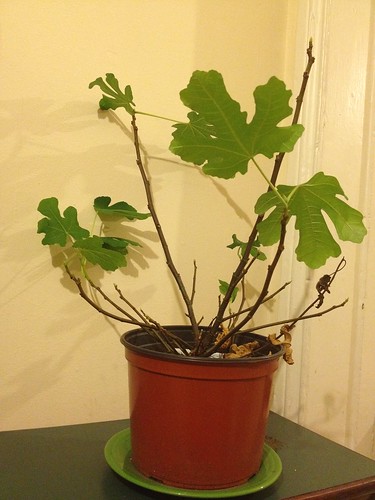 [/caption]
I can't even tell you how many houseplants I've killed. Seriously, I've lost count. And we're not just talking delicate plants here: people, I've killed cacti. CACTI. You know, those things that grow in the desert? With hardly any water? Well, turns out if you forget to water anything for long enough, it will die. Luckily most cacti don't look too different whether they're dead or alive so I may be guilty of gluing a small fabric flower to a dead cactus to alleviate the pain. I don't recommend it, though, because the relief is short-lived.
In this past year I've learned that I can indeed grow things. But growing a garden (even a garden of containers) outside is entirely different from growing things inside. Because outdoor plants are super easy. Outdoor plants always get what they need - sun and water. It may be cloudy one day but they still get sun, and it may not rain for a while but it will again. You know where it doesn't rain? Inside. And somehow I just forget to water plants that are inside. It's like I see them as some sort of furniture and just completely overlook the fact that they need watering. And then a week's gone by and oh! why is that plant turning brown?
I'm trying to get better about not forgetting about my houseplants and I think it's working a bit but I've already killed one palm this year and another is getting preeeeetty close. One trick I've found is to put the plants in places that you look at often. This lovely little aloe is in the kitchen window, for instance:
[caption id="" align="alignnone" width="375" caption="prickly little thing"]
[/caption]
I can't even tell you how many houseplants I've killed. Seriously, I've lost count. And we're not just talking delicate plants here: people, I've killed cacti. CACTI. You know, those things that grow in the desert? With hardly any water? Well, turns out if you forget to water anything for long enough, it will die. Luckily most cacti don't look too different whether they're dead or alive so I may be guilty of gluing a small fabric flower to a dead cactus to alleviate the pain. I don't recommend it, though, because the relief is short-lived.
In this past year I've learned that I can indeed grow things. But growing a garden (even a garden of containers) outside is entirely different from growing things inside. Because outdoor plants are super easy. Outdoor plants always get what they need - sun and water. It may be cloudy one day but they still get sun, and it may not rain for a while but it will again. You know where it doesn't rain? Inside. And somehow I just forget to water plants that are inside. It's like I see them as some sort of furniture and just completely overlook the fact that they need watering. And then a week's gone by and oh! why is that plant turning brown?
I'm trying to get better about not forgetting about my houseplants and I think it's working a bit but I've already killed one palm this year and another is getting preeeeetty close. One trick I've found is to put the plants in places that you look at often. This lovely little aloe is in the kitchen window, for instance:
[caption id="" align="alignnone" width="375" caption="prickly little thing"]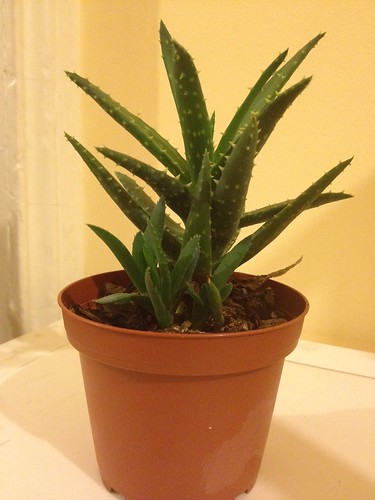 [/caption]
The window this guy is in is conveniently next to the sink and dish drying rack (and right above where the cats are fed) so I'm sure to look at it at least once a day. Being near the sink also means it's super easy to water - just turn the faucet on to just over a drip and dribble the water in until it comes out the holes in the bottom. Fantastic! The only thing with plants in windows is that you need to remember to turn them once in a while unless you want them to grow towards the window, where the most sun is. You can see that this guy has lots of little new growth on the front left-hand side there; clearly that was the part closest to the window.
After some trial and error with houseplants (don't worry guys, it only takes, like, 10 years) you'll start to find which plants work best for you. I seem to do well with succulents like aloe because they can get very dry without dying, and they're also used to large amounts of water at once, like in a desert. Other things, like palms (cough cough) are tough because the soil needs to be kept sufficiently damp and that means watering less each time but more frequently. Let me tell you: that is not how I roll. I find it very hard to water just a little - when I water I assume I won't be watering the next day so I tend to soak the plants a little more than I should, probably. This works out great in the garden in the summer because those plants need all the water they can get. But inside, plants don't need as much water and I've always found it hard to know when I was under- or overwatering until the plant starts to actually show signs of either, when it's usually too late.
[caption id="" align="alignnone" width="375" caption="my other fig, with cats (for scale)"]
[/caption]
The window this guy is in is conveniently next to the sink and dish drying rack (and right above where the cats are fed) so I'm sure to look at it at least once a day. Being near the sink also means it's super easy to water - just turn the faucet on to just over a drip and dribble the water in until it comes out the holes in the bottom. Fantastic! The only thing with plants in windows is that you need to remember to turn them once in a while unless you want them to grow towards the window, where the most sun is. You can see that this guy has lots of little new growth on the front left-hand side there; clearly that was the part closest to the window.
After some trial and error with houseplants (don't worry guys, it only takes, like, 10 years) you'll start to find which plants work best for you. I seem to do well with succulents like aloe because they can get very dry without dying, and they're also used to large amounts of water at once, like in a desert. Other things, like palms (cough cough) are tough because the soil needs to be kept sufficiently damp and that means watering less each time but more frequently. Let me tell you: that is not how I roll. I find it very hard to water just a little - when I water I assume I won't be watering the next day so I tend to soak the plants a little more than I should, probably. This works out great in the garden in the summer because those plants need all the water they can get. But inside, plants don't need as much water and I've always found it hard to know when I was under- or overwatering until the plant starts to actually show signs of either, when it's usually too late.
[caption id="" align="alignnone" width="375" caption="my other fig, with cats (for scale)"]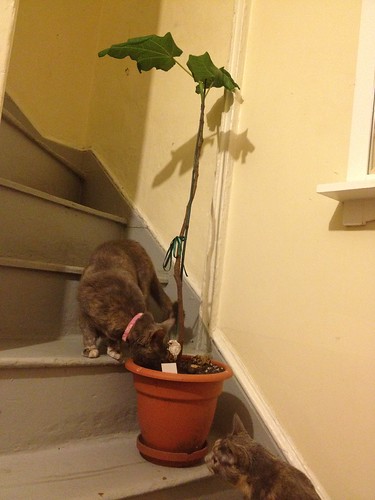 [/caption]
These figs that I've shown you pictures of are strange things, indeed. Allow me to tell you a story: Last winter, I had a fig. It was a special black fig and I may have referenced it above. It came with pages of directions, and to overwinter you were supposed to put it in a cool, dark place, let all the leaves fall off, and water only occasionally. This lets it do the plant equivalent of hibernating and then will begin to bud again in the spring, when you resume watering it and putting it in the sun like a regular plant. Like I said, watering is a problem of mine. And since the fig needed to be watered less than any other plant, I kind of forgot about it. But then spring came and there was a little green bud and I got excited! That is, until the bud dried up and fell off a few days later. That was the end of that fig. Then I got two new figs. The tall, skinny one is from that same fig-growing man in Massachusetts. The shorter, bushier one is from the farmer's market in Rittenhouse Square. I actually forgot about the whole hibernating for the winter thing, but the leaves started falling off both of them. I kept watering and kept them in the sun and soon new leaves started appearing! Now both figs have leaves and buds so I'm hoping I did this right. It's certainly more encouraging than the stick I was watering last year.
The next thing about houseplants that I've learned is to have a good, big watering can. I used to water my plants with whatever was handy and clean - various pitchers work well for this. But they're all too small for the amount of plants I have now so I end up making multiple trips to the faucet, which in turn makes the act of watering that much longer. I will make any excuse I can not to water (the usual being that it takes too long even though it doesn't take that long) so having a big watering can that I can fill up once and water everything with is key.
[caption id="" align="alignnone" width="375" caption="captain walker inspects"]
[/caption]
These figs that I've shown you pictures of are strange things, indeed. Allow me to tell you a story: Last winter, I had a fig. It was a special black fig and I may have referenced it above. It came with pages of directions, and to overwinter you were supposed to put it in a cool, dark place, let all the leaves fall off, and water only occasionally. This lets it do the plant equivalent of hibernating and then will begin to bud again in the spring, when you resume watering it and putting it in the sun like a regular plant. Like I said, watering is a problem of mine. And since the fig needed to be watered less than any other plant, I kind of forgot about it. But then spring came and there was a little green bud and I got excited! That is, until the bud dried up and fell off a few days later. That was the end of that fig. Then I got two new figs. The tall, skinny one is from that same fig-growing man in Massachusetts. The shorter, bushier one is from the farmer's market in Rittenhouse Square. I actually forgot about the whole hibernating for the winter thing, but the leaves started falling off both of them. I kept watering and kept them in the sun and soon new leaves started appearing! Now both figs have leaves and buds so I'm hoping I did this right. It's certainly more encouraging than the stick I was watering last year.
The next thing about houseplants that I've learned is to have a good, big watering can. I used to water my plants with whatever was handy and clean - various pitchers work well for this. But they're all too small for the amount of plants I have now so I end up making multiple trips to the faucet, which in turn makes the act of watering that much longer. I will make any excuse I can not to water (the usual being that it takes too long even though it doesn't take that long) so having a big watering can that I can fill up once and water everything with is key.
[caption id="" align="alignnone" width="375" caption="captain walker inspects"]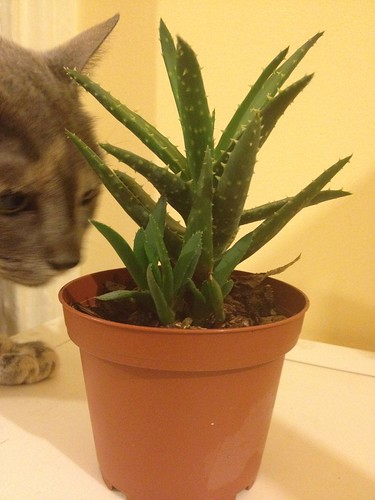 [/caption]
Another important thing about houseplants is that some are poisonous to humans and animals. And something that is safe for humans might be poisonous to animals and vice versa. So if you have small kids or pets that tend to eat things they shouldn't, you should make sure that all your houseplants are safe in case some do get eaten. We have two cats, one of whom, Mr. Hooper, will eat literally anything you put in front of her. When other cats sniff things to inspect them, she just eats them and then throws up later, if needed. The cat in the picture above, Walker, is very picky and will usually not eat random things. But the other night, Walker was in my room and I heard the sound of crunching on what sounded like a dry leaf...I look down and Walker is happily chewing a dead leaf from my rex begonia that is in my room for the winter. Of course I immediately freaked out and googled "are rex begonias poisonous to cats" (gotta love Google) and found, to my relief, that rex begonias are non-toxic to cats. Something that is toxic to cats is aloe, so my picture above should be used as a caution! But knowing Walker I knew that she just wanted to sniff, which is what she did. Also this particular aloe is very prickly so I don't think even Hooper, The Cat Who Eats Everything, would risk it. But just in case, it's on the kitchen windowsill where they can't get to. This is the only plant that I would risk doing that with because of the spikes and because Hooper can't jump that high; cats (and little kids) are really tricky and if they see a plant they want to eat they're going to get it one way or another.
I guess the moral of this story (post) is that if you're always killing houseplants, don't immediately assume you can't grow anything cause houseplants are really hard. And if you can grow houseplants then good for you! Could you please share some tips?
[/caption]
Another important thing about houseplants is that some are poisonous to humans and animals. And something that is safe for humans might be poisonous to animals and vice versa. So if you have small kids or pets that tend to eat things they shouldn't, you should make sure that all your houseplants are safe in case some do get eaten. We have two cats, one of whom, Mr. Hooper, will eat literally anything you put in front of her. When other cats sniff things to inspect them, she just eats them and then throws up later, if needed. The cat in the picture above, Walker, is very picky and will usually not eat random things. But the other night, Walker was in my room and I heard the sound of crunching on what sounded like a dry leaf...I look down and Walker is happily chewing a dead leaf from my rex begonia that is in my room for the winter. Of course I immediately freaked out and googled "are rex begonias poisonous to cats" (gotta love Google) and found, to my relief, that rex begonias are non-toxic to cats. Something that is toxic to cats is aloe, so my picture above should be used as a caution! But knowing Walker I knew that she just wanted to sniff, which is what she did. Also this particular aloe is very prickly so I don't think even Hooper, The Cat Who Eats Everything, would risk it. But just in case, it's on the kitchen windowsill where they can't get to. This is the only plant that I would risk doing that with because of the spikes and because Hooper can't jump that high; cats (and little kids) are really tricky and if they see a plant they want to eat they're going to get it one way or another.
I guess the moral of this story (post) is that if you're always killing houseplants, don't immediately assume you can't grow anything cause houseplants are really hard. And if you can grow houseplants then good for you! Could you please share some tips?
Share
[/caption]
I can't even tell you how many houseplants I've killed. Seriously, I've lost count. And we're not just talking delicate plants here: people, I've killed cacti. CACTI. You know, those things that grow in the desert? With hardly any water? Well, turns out if you forget to water anything for long enough, it will die. Luckily most cacti don't look too different whether they're dead or alive so I may be guilty of gluing a small fabric flower to a dead cactus to alleviate the pain. I don't recommend it, though, because the relief is short-lived.
In this past year I've learned that I can indeed grow things. But growing a garden (even a garden of containers) outside is entirely different from growing things inside. Because outdoor plants are super easy. Outdoor plants always get what they need - sun and water. It may be cloudy one day but they still get sun, and it may not rain for a while but it will again. You know where it doesn't rain? Inside. And somehow I just forget to water plants that are inside. It's like I see them as some sort of furniture and just completely overlook the fact that they need watering. And then a week's gone by and oh! why is that plant turning brown?
I'm trying to get better about not forgetting about my houseplants and I think it's working a bit but I've already killed one palm this year and another is getting preeeeetty close. One trick I've found is to put the plants in places that you look at often. This lovely little aloe is in the kitchen window, for instance:
[caption id="" align="alignnone" width="375" caption="prickly little thing"][/caption]
The window this guy is in is conveniently next to the sink and dish drying rack (and right above where the cats are fed) so I'm sure to look at it at least once a day. Being near the sink also means it's super easy to water - just turn the faucet on to just over a drip and dribble the water in until it comes out the holes in the bottom. Fantastic! The only thing with plants in windows is that you need to remember to turn them once in a while unless you want them to grow towards the window, where the most sun is. You can see that this guy has lots of little new growth on the front left-hand side there; clearly that was the part closest to the window.
After some trial and error with houseplants (don't worry guys, it only takes, like, 10 years) you'll start to find which plants work best for you. I seem to do well with succulents like aloe because they can get very dry without dying, and they're also used to large amounts of water at once, like in a desert. Other things, like palms (cough cough) are tough because the soil needs to be kept sufficiently damp and that means watering less each time but more frequently. Let me tell you: that is not how I roll. I find it very hard to water just a little - when I water I assume I won't be watering the next day so I tend to soak the plants a little more than I should, probably. This works out great in the garden in the summer because those plants need all the water they can get. But inside, plants don't need as much water and I've always found it hard to know when I was under- or overwatering until the plant starts to actually show signs of either, when it's usually too late.
[caption id="" align="alignnone" width="375" caption="my other fig, with cats (for scale)"][/caption]
These figs that I've shown you pictures of are strange things, indeed. Allow me to tell you a story: Last winter, I had a fig. It was a special black fig and I may have referenced it above. It came with pages of directions, and to overwinter you were supposed to put it in a cool, dark place, let all the leaves fall off, and water only occasionally. This lets it do the plant equivalent of hibernating and then will begin to bud again in the spring, when you resume watering it and putting it in the sun like a regular plant. Like I said, watering is a problem of mine. And since the fig needed to be watered less than any other plant, I kind of forgot about it. But then spring came and there was a little green bud and I got excited! That is, until the bud dried up and fell off a few days later. That was the end of that fig. Then I got two new figs. The tall, skinny one is from that same fig-growing man in Massachusetts. The shorter, bushier one is from the farmer's market in Rittenhouse Square. I actually forgot about the whole hibernating for the winter thing, but the leaves started falling off both of them. I kept watering and kept them in the sun and soon new leaves started appearing! Now both figs have leaves and buds so I'm hoping I did this right. It's certainly more encouraging than the stick I was watering last year.
The next thing about houseplants that I've learned is to have a good, big watering can. I used to water my plants with whatever was handy and clean - various pitchers work well for this. But they're all too small for the amount of plants I have now so I end up making multiple trips to the faucet, which in turn makes the act of watering that much longer. I will make any excuse I can not to water (the usual being that it takes too long even though it doesn't take that long) so having a big watering can that I can fill up once and water everything with is key.
[caption id="" align="alignnone" width="375" caption="captain walker inspects"][/caption]
Another important thing about houseplants is that some are poisonous to humans and animals. And something that is safe for humans might be poisonous to animals and vice versa. So if you have small kids or pets that tend to eat things they shouldn't, you should make sure that all your houseplants are safe in case some do get eaten. We have two cats, one of whom, Mr. Hooper, will eat literally anything you put in front of her. When other cats sniff things to inspect them, she just eats them and then throws up later, if needed. The cat in the picture above, Walker, is very picky and will usually not eat random things. But the other night, Walker was in my room and I heard the sound of crunching on what sounded like a dry leaf...I look down and Walker is happily chewing a dead leaf from my rex begonia that is in my room for the winter. Of course I immediately freaked out and googled "are rex begonias poisonous to cats" (gotta love Google) and found, to my relief, that rex begonias are non-toxic to cats. Something that is toxic to cats is aloe, so my picture above should be used as a caution! But knowing Walker I knew that she just wanted to sniff, which is what she did. Also this particular aloe is very prickly so I don't think even Hooper, The Cat Who Eats Everything, would risk it. But just in case, it's on the kitchen windowsill where they can't get to. This is the only plant that I would risk doing that with because of the spikes and because Hooper can't jump that high; cats (and little kids) are really tricky and if they see a plant they want to eat they're going to get it one way or another.
I guess the moral of this story (post) is that if you're always killing houseplants, don't immediately assume you can't grow anything cause houseplants are really hard. And if you can grow houseplants then good for you! Could you please share some tips?
Happy Valentine's Day
Happy Valentine's Day! I hope you are wrapping it up at work and heading home to your loved ones.  I just wanted to quickly pop in and say that we had a great time on Sunday, devouring tons of sweets.


 The talented Chef Chad Durkin showed us how to make whoopie pies and an adult chocolate milk. All throughout the demo, he shared great tips such as ways to "repurpose" ingredients -using beet juice to dye red velvet cake, infusing vodka with coffee beans to make fun cocktails, and creating your own vanilla extract by submerging vanilla bean pods in bourbon or rum.
Martin Brown, from Little Baby's Ice Cream, was also there serving up some delicious chipotle chocolate ice cream and vegan ice cream made from coconut milk, chocolate and peanut chews (who knew peanut chews were vegan?).
Thanks to Albert Yee who was there to capture it all for us!
The talented Chef Chad Durkin showed us how to make whoopie pies and an adult chocolate milk. All throughout the demo, he shared great tips such as ways to "repurpose" ingredients -using beet juice to dye red velvet cake, infusing vodka with coffee beans to make fun cocktails, and creating your own vanilla extract by submerging vanilla bean pods in bourbon or rum.
Martin Brown, from Little Baby's Ice Cream, was also there serving up some delicious chipotle chocolate ice cream and vegan ice cream made from coconut milk, chocolate and peanut chews (who knew peanut chews were vegan?).
Thanks to Albert Yee who was there to capture it all for us!
Share
I just wanted to quickly pop in and say that we had a great time on Sunday, devouring tons of sweets.


 The talented Chef Chad Durkin showed us how to make whoopie pies and an adult chocolate milk. All throughout the demo, he shared great tips such as ways to "repurpose" ingredients -using beet juice to dye red velvet cake, infusing vodka with coffee beans to make fun cocktails, and creating your own vanilla extract by submerging vanilla bean pods in bourbon or rum.
Martin Brown, from Little Baby's Ice Cream, was also there serving up some delicious chipotle chocolate ice cream and vegan ice cream made from coconut milk, chocolate and peanut chews (who knew peanut chews were vegan?).
Thanks to Albert Yee who was there to capture it all for us!
The talented Chef Chad Durkin showed us how to make whoopie pies and an adult chocolate milk. All throughout the demo, he shared great tips such as ways to "repurpose" ingredients -using beet juice to dye red velvet cake, infusing vodka with coffee beans to make fun cocktails, and creating your own vanilla extract by submerging vanilla bean pods in bourbon or rum.
Martin Brown, from Little Baby's Ice Cream, was also there serving up some delicious chipotle chocolate ice cream and vegan ice cream made from coconut milk, chocolate and peanut chews (who knew peanut chews were vegan?).
Thanks to Albert Yee who was there to capture it all for us!
Where we've been and where we're going!
It certainly has been a whirlwind few weeks, what with our great fund raiser at The Cantina (where we welcomed 6 new member-owners), our presentation at the Dickinson Narrows Civic Association (4 new member-owners) and last night's appearance at Drexel University for the screening of Urban Roots (1 new member-owner... but we were all the way over at 31st and Market... that's like traveling to Cleveland and having someone join the Co-op!) And by the way, I really do recommend that you see Urban Roots. I have it on DVD if you want to borrow it.
So our unofficial count as of yesterday, according to board member Cassie Plummer's posting on Facebook, was 175 (plus 1 from last night, we'll call it 176).
And we're not slowing down.
Tonight we take a little break to kick back and celebrate the International Year of the Cooperative with the Philadelphia Area Cooperative Alliance, a newly formed group linking together many of the established and start-up co-ops in the area. The event will take place at Fergie's Pub, upstairs, at 12th and Sansom starting at 6pm. Free appetizers. Cash bar. Great opportunity to see people you've met through the process of becoming a member or attending one of our previous events. I said we'll be kicking back to celebrate but if you really want to make it a great night, bring that member-owner application and check for your equity that you've been holding onto for the last several weeks.
And, of course, on Sunday we invite you all (member-owners and not-yet-member-owners) to "Love Your Co-op" with Food Network challenge veteran and pastry chef Chad Durkin. Join us for chocolate, cheese and wine tasting as well as a demonstration by Chef Durkin. He’ll be demonstrating an easy to make at home dessert that you can replicate for your loved one on February 14th. In addition to the demonstration, you can enjoy complimentary chocolate, cheese, wine, Little Baby’s Ice Cream, and a chocolate fountain with fruit, pretzels, and pound cake! This is a ticketed event and there is an afternoon and an evening session. Space is limited and at just $12 per ticket ($7 for member-owners, free kids younger than 12) available tickets are going fast. Click here for more details including links to buying tickets online. Join the Co-op today and you can still get that discounted ticket price.
And we haven't forgotten about your youngest member-owners. On Wednesday, February 29 from 5pm to 8pm, we're hosting Kids Night at the Grindcore Coffee House (SE corner of 4th and Greenwich - between Dickinson and Tasker). Parents with young children are encouraged to attend to meet and greet with other co-op parents and kids. We'll have fun crafts for the kids to create with and will be showing cartoons on a projector. Delicious coffee, teas, and treats are available in the coffee house (a member of our Shop South Philly Program) which specializes in vegan and sustainable practices.
Finally, block off Saturday, April 28th for our 2nd Anniversary Celebration at the Passyunk Gardens. We'll have live music, raffles and an after-party at Devil's Den. More details to follow. Just don't plan anything else for 4-28, mmmkay? Because hopefully we'll be celebrating our 250 Founding Members that day as well!
Share